
Part 1: Routing Fundamentals, Static & Dynamic Routes, and Basics
Build a strong foundation in routing before diving into OSPF — static vs dynamic routes and routing concepts demystified.

Why Routing Matters?
Have you ever wondered how your message reaches a friend halfway across the globe in the blink of an eye? Every packet of data travels a precise path through countless routers — and the technology making these decisions is called routing.
Every second, millions of packets race across the internet, hopping from router to router, always finding the fastest and safest path without getting lost.
Routing is the hidden backbone of our digital world. Let’s uncover how it works.
Routing Fundamentals
Routing shows the paths packets take to reach remote networks. We can see these paths in a router’s Routing table. But who decides which routes go into the routing table? There are two main ways
Static Routes
Used in small networks where we have a clear picture of the topology and know exactly what is connected.
Works well for simple setups, but in large networks, manually writing routes becomes difficult and impractical.
Static routes are manually configured paths in a router — simple and predictable, but hard to manage in large networks
Dynamic Routes
In larger networks, knowing the complete topology is a challenge, especially when multiple engineers manage different parts of the network.
Deciding the best path for each destination is another challenge. Simply knowing the physical connections isn’t enough — we can see the number of wires, but we don’t know their bandwidth, delay, MTU, reliability, or load. Routers cannot measure these factors on their own.
That’s why we rely on routing protocols, which automatically calculate the optimal paths and update the routing table as network conditions change.
Routing protocols automatically calculate and update the best paths in a network based on current condition
We have two broad categories of routing protocols: IGP (Interior Gateway Protocols) and EGP (Exterior Gateway Protocols).
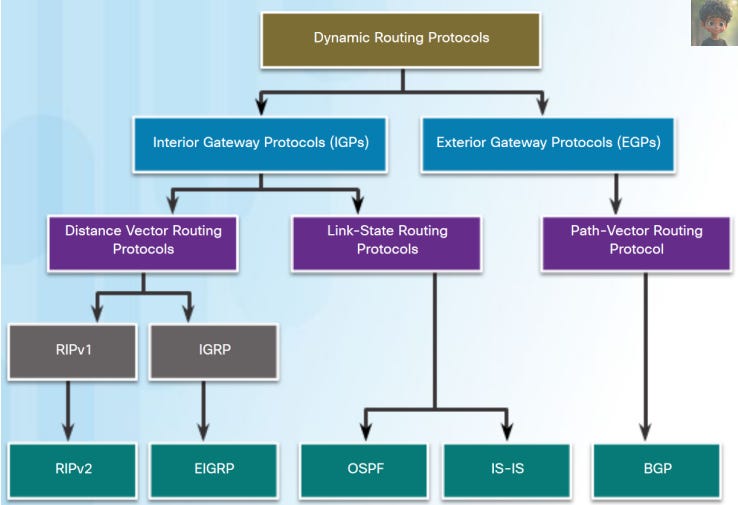
Introduction to OSPF
OSPF is built on an algorithm called SPF (Shortest Path First), also known as Dijkstra’s Algorithm — named after Edsger Dijkstra, the computer scientist who first introduced it. Sometimes it’s also referred to as a tree-based algorithm, because it calculates the shortest path by building a tree of possible routes.
The routing protocol designed around this algorithm is called OSPF. The word “Open” means it is an industry standard, available for anyone to implement — unlike some proprietary protocols.
OSPF is an Interior Gateway Protocol based on Dijkstra’s Shortest Path First algorithm
Link-State Routing Protocols work differently from Distance Vector protocols. Instead of just sharing information about which networks they know, routers exchange detailed updates about the state of their links.
These updates are called Link State Advertisements (LSAs). Using LSAs, each router learns which remote networks exist in the topology and the cost (metrics) to reach them
With this information, every router can independently build a shortest-path tree of the entire network and then choose the best paths for its routing table.
You’ve now seen how Link-State routing protocols give every router a complete map of the network. But how does this magic actually start? Do routers really say ‘Hello’ to each other before sharing their maps? And what secret conversations happen after that?
👉 In the next part of the series, we’ll dive into OSPF’s first steps — “the Hello protocol, neighbor relationships, and how routers begin to trust each other before exchanging routes.”